
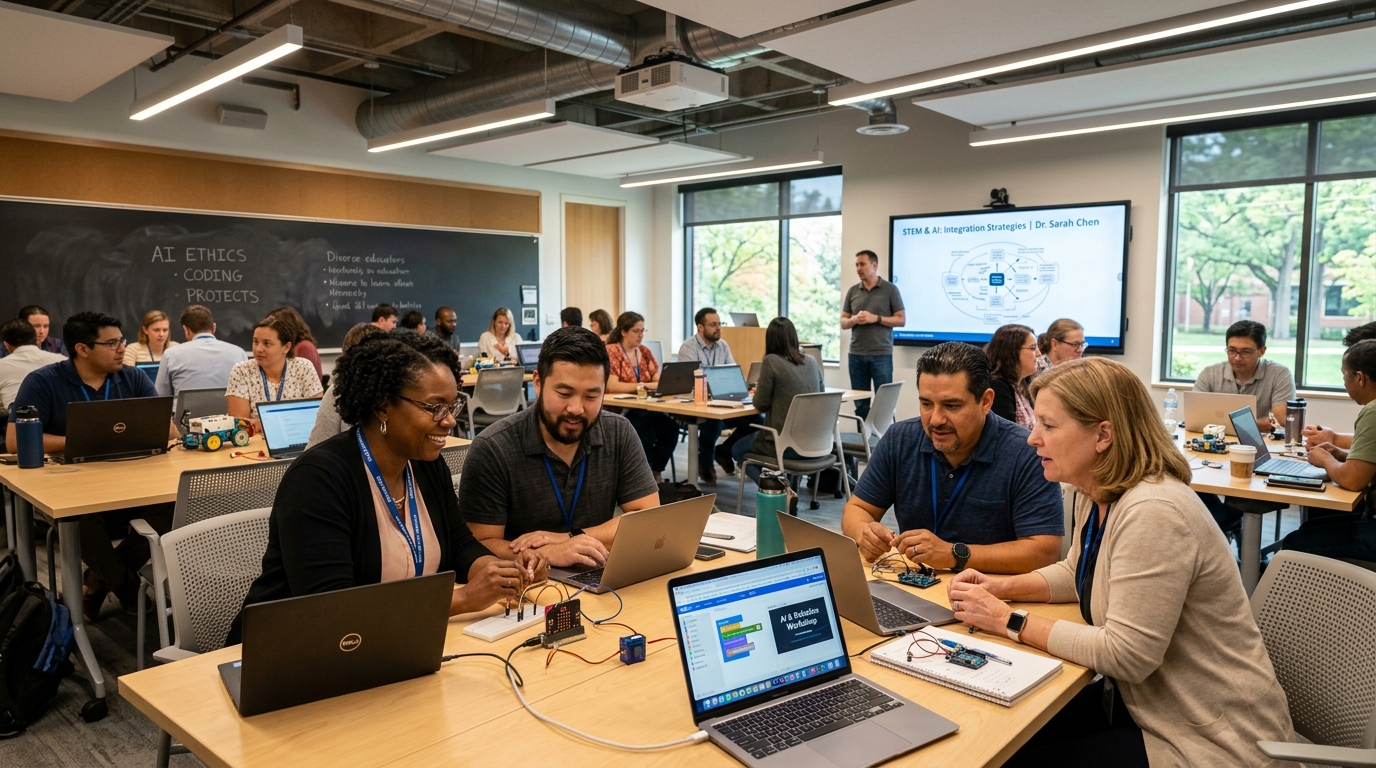
As the global educational landscape undergoes rapid transformation driven by Artificial Intelligence, advanced robotics, automation, and the Internet of Things (IoT), the demands placed on classrooms have never been higher. To effectively prepare students for dynamic careers in the 21st-century digital economy, pedagogical approaches must evolve far beyond traditional rote memorization. At the epicenter of this educational transformation stands the teacher.
Teacher empowerment and continuous upskilling are no longer optional professional development perks—they are the vital foundation of student achievement, institutional excellence, and holistic skill readiness.
“When you empower and upskill one educator, you unlock the creative potential and technological confidence of hundreds of students every single year. Teachers are the true multipliers of educational innovation.”
1. The Reality of the Digital Pedagogy Gap
Today's students are digital natives who consume technology continuously, yet channeling that enthusiasm into constructive invention requires expert mentorship. Frequently, educators face anxiety when tasked with teaching emerging technologies such as Python coding, embedded robotics, or AI algorithms without structured, hands-on experiential training. Empowering teachers with practical technical competencies eliminates curriculum intimidation, replacing uncertainty with passionate, confident classroom leadership.
2. Moving from Theory to Hands-on Facilitation
Modern STEM and technical education demands a shift from lecture-style instruction to active, inquiry-based facilitation. Through targeted upskilling workshops and Faculty Development Programs (FDPs), teachers master the ability to:
- Design and deliver interactive coding sessions using Scratch, PictoBlox, and Python.
- Guide students through electronic circuit design, sensor interfacing, and microcontrollers (Arduino, ESP32, Micro:bit).
- Mentor students through the iterative engineering design cycle: empathize, brainstorm, prototype, test, and iterate.
- Facilitate real-world problem-solving challenges that link academic concepts in mathematics and physics to tangible working prototypes.
3. Cultivating Critical Thinking & Lifelong Learning in Students
When educators embrace continuous learning, they model the exact mindset students require for future resilience. An upskilled educator does not simply teach syntax or hardware connections; they inspire curiosity, encourage ethical considerations around emerging tech (such as responsible AI usage), and demonstrate how to learn independently in an ever-shifting technological landscape.
4. Measurable Outcomes: Higher Engagement and Competitiveness
Schools and colleges that invest in structured teacher empowerment witness immediate, transformative outcomes:
- Elevated Classroom Engagement: Lectures transform into vibrant maker workshops where student attendance, curiosity, and project completion rates soar.
- Success in National STEM Competitions: Upskilled mentors successfully guide student teams to win regional and national robotics hackathons, ATL innovation challenges, and science exhibitions.
- Robust Student Portfolios: Students graduate with credible, real-world project portfolios that significantly enhance their higher education admissions and career placement opportunities.
5. AxiLearn’s Commitment to Faculty Development Programs (FDP)
At AxiLearn, we firmly believe that institutional transformation begins with faculty empowerment. Our specialized Faculty Development Programs (FDP) and Educator Masterclasses provide rigorous hands-on training in Robotics, AI/ML, IoT, 3D printing, and modern experiential pedagogy. We equip educators with turn-key lesson plans, certified hardware kits, and continuous mentorship—empowering them to lead the classrooms of tomorrow with mastery and confidence.
Authoritative Sources & Global Frameworks:
- World Economic Forum (WEF) – Future of Jobs Report: Emerging Skills, AI Disruption & STEM Competencies.
- OECD Future of Education and Skills 2030 – Teachers as Catalysts for Agency and Transformative Competencies.
- Ministry of Education & NITI Aayog – Continuous Professional Development (CPD) & Teacher Upskilling Mandates.
- IEEE Education Society – Global Standards for Robotics, AI & Engineering Instruction in K-12 and Higher Education.
