
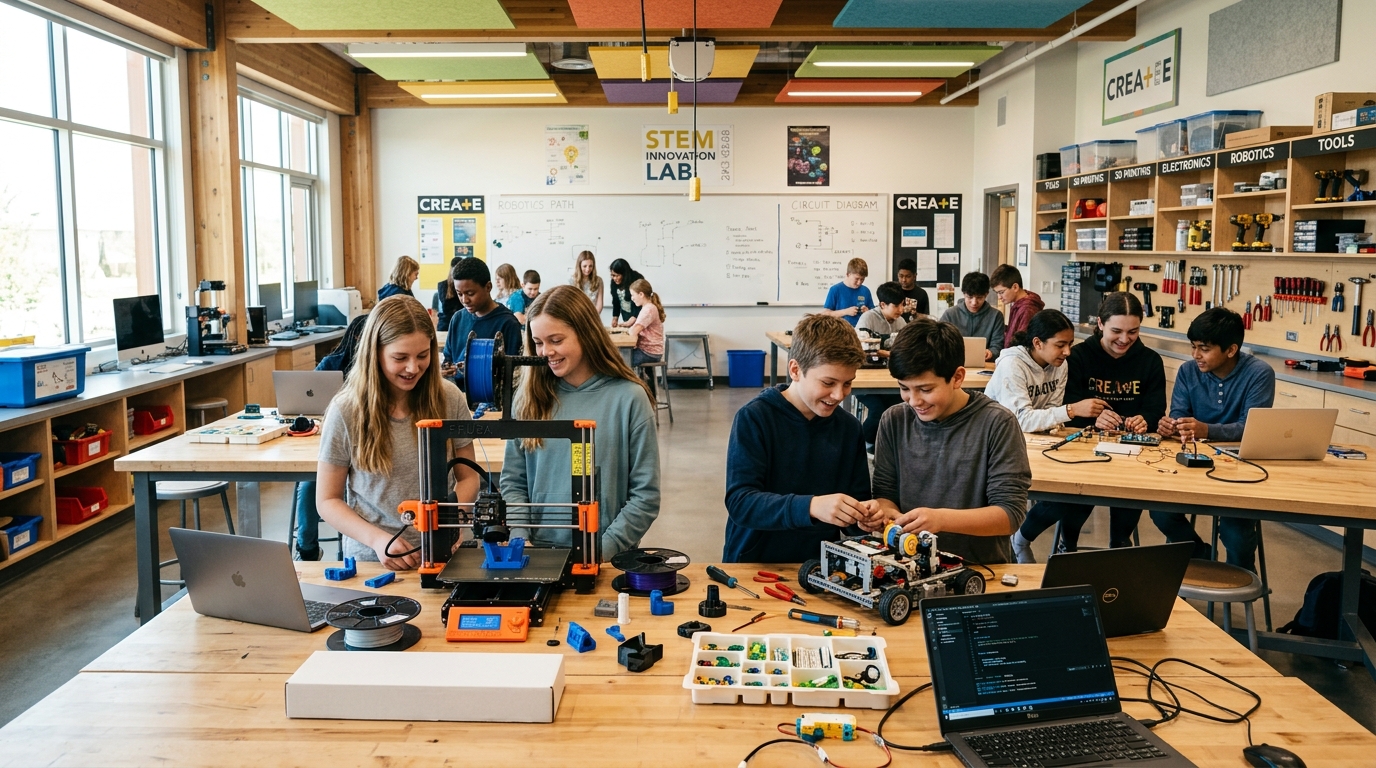
In an era where technology evolves at an unprecedented pace, traditional rote-learning classrooms are rapidly giving way to dynamic, experiential learning environments. Among the most transformative developments in modern education is the School Makerspace—a dedicated, collaborative innovation lab where students turn abstract theoretical concepts in Science, Technology, Engineering, Arts, and Mathematics (STEAM) into tangible, real-world creations.
Whether assembling autonomous robots, rapid-prototyping with 3D printers, engineering IoT environmental sensors, or writing code to automate smart devices, a well-designed makerspace nurtures critical thinking, creative resilience, and future-ready problem-solving capabilities in students of all grade levels.
“A school makerspace is not merely a collection of high-tech machinery; it is a creative mindset and an ecosystem that empowers students to evolve from passive consumers of technology into confident, inventive creators and problem solvers.”
1. Defining the Core Vision & Educational Goals
Before procuring hardware or furniture, school leadership and educators must define their vision. Is the makerspace intended for daily classroom curriculum integration, after-school robotics clubs, inter-school STEM competitions, or open-ended design-thinking challenges? Establishing clear pedagogical objectives ensures that every workbench, toolset, and development kit delivers measurable learning outcomes.
2. Strategic Zoning: The Blueprint of an Effective Lab
A productive makerspace balances open collaboration with organized workflow and safety. The most effective layout utilizes distinct functional zones:
- Ideation & Design Hub: Equipped with mobile whiteboards, modular seating, and computers/tablets for brainstorming, research, and 3D modeling using CAD software like Tinkercad and Fusion 360.
- Digital Fabrication Center: Houses rapid prototyping hardware such as enclosed FDM 3D printers, laser cutters, and vinyl plotters placed on heavy-duty, vibration-dampened surfaces with dedicated ventilation.
- Electronics & Prototyping Station: An ESD-safe electronics workbench featuring soldering stations, multimeters, DC power supplies, Arduino microcontrollers, Raspberry Pi single-board computers, and comprehensive sensor arrays.
- Mechanical Assembly Area: Sturdy wooden workbenches with organized pegboards for hand tools, screwdrivers, drills, pliers, measuring calipers, and mechanical prototyping kits.
- Robotics Testing & Simulation Arena: An open, clutter-free central arena or competition mat where students can drive robots, test autonomous navigation, and calibrate sensor feedback loops in real-time.
3. Safety Protocols & Lab Culture
Safety is the foundation of every successful innovation lab. Best practices include:
- Clear demarcation of machine safety zones and high-temperature work areas.
- Readily accessible first-aid kits, eye-wash stations, fire extinguishers, and master emergency power kill-switches.
- Mandatory Personal Protective Equipment (PPE) including safety glasses and heat-resistant handling gloves.
- A structured "Tool Mastery & Machine Certification" badge system that rewards students with independent machine operating privileges once safety checks are mastered.
4. Curating the Technology Stack & Equipment
Schools can scale their makerspaces incrementally based on grade levels and budget:
- Elementary & Middle School: Block-based coding platforms (Scratch, PictoBlox), Micro:bit microcontrollers, paper circuits, craft electronics, and intuitive 3D design software.
- High School & Advanced Programs: Arduino C/C++ programming, Python for IoT, FDM 3D printing slicing software, ROS-based robotics kits, AI computer vision cameras, and cloud dashboard integrations.
5. Integrating Curriculum & Building Maker Culture
The true magic of a makerspace happens when it bridges multiple subjects. Physics students model projectile motion with catapults, Biology classes design automated hydroponic monitoring systems, and Math students write code to visualize complex geometric fractals. Organizing annual maker expos, school hackathons, and science exhibitions celebrates student achievement and keeps enthusiasm vibrant all year round.
Authoritative Sources & Educational Frameworks:
- Atal Innovation Mission (AIM), NITI Aayog – Atal Tinkering Labs (ATL) Standard Operating Guidelines & Pedagogical Framework.
- National Education Policy (NEP 2020) – Guidelines on 21st-Century Skilling, Experiential Learning & Hands-on Science Labs.
- MIT Media Lab (Lifelong Kindergarten Group) – Research on Maker Education, Creative Learning Loops, and Constructionist Pedagogy.
- UNESCO STEM Education Policy – Fostering Innovation, Problem Solving, and Digital Competence in Global K-12 Education.
At AxiLearn, we partner with schools and educational institutions to provide end-to-end makerspace planning, hardware provisioning, certified curriculum frameworks, and faculty mentorship to ensure every lab setup is a resounding success.
